Give it a real brief. It still does the same things.
In October I gave AI models a two-sentence brief for a made-up invoicing tool and counted what they put on the page. Fourteen of the eighteen pages added a pricing section I hadn't asked for, with made-up prices. Eleven added testimonials, with invented quotes from invented studios. The human-designed sites I compared them with had changelogs, founder letters and customer stories, because they were about real companies.
The fair objection is that my brief gave the models nothing real to work with. A two-sentence brief for a product that doesn't exist leaves every gap open, and the models filled the gaps in the same way. In the October 25 test I wrote that I hadn't tried changing the audience or the requirements. So this time I wanted briefs written by real people, for pages they actually wanted made.
Where the briefs came from
WildChat is a public collection of about a million conversations people had with ChatGPT, through a free chatbot that researchers at the Allen Institute for AI ran from April 2023 to April 2024. I had already pulled 31 requests from it where someone asked for a small-business website. I kept the 19 where the ask was a website, a page or the content for a page. The 12 I dropped were things like edits to existing code, role-play consulting and a smart-contract app.
Real requests vary a lot. Some are long and specific, with names and details. Others are as short as this one, exactly as the person typed it:
make me a coffee shop website using html, css, javascript. put everything that is necessary and make it look really good and aesthetically pleasing
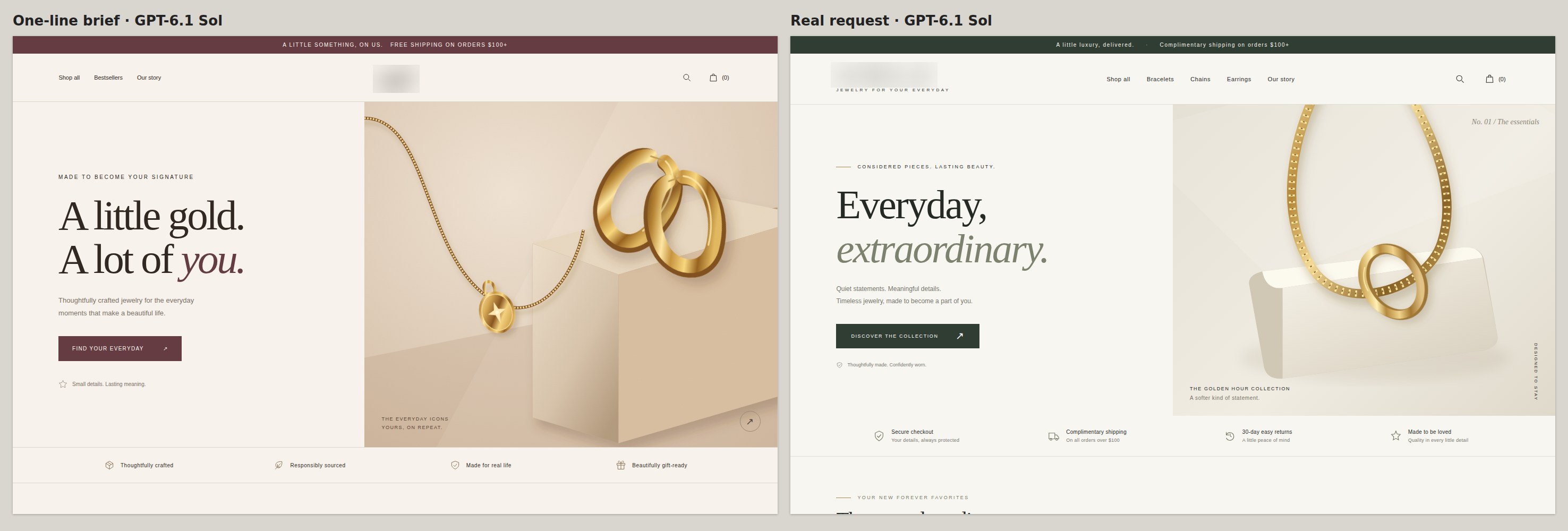
Each model got the request as written, followed by the same format line every brief got: "Return one self-contained HTML file with inline CSS. No external images." It also got a one-line version built from a template, like "Design the landing page for a coffee shop business.", with the same line after it. That's close to the kind of brief I used in October. Because it's a template, a few versions read awkwardly, like "a online puppet toy store business".
Seven models from six labs built a page from each version: Claude Haiku 5.5, Gemini 3.8 Flash, DeepSeek V4.1 Flash and Qwen 3.8 Max, then Claude Sonnet 5.5, GPT-6.1 Sol and Grok 4.7. I added the last three in a second run, and wrote that change into the plan before looking at any results. That gave 266 pages, or 133 pairs where the only difference was the brief. Thirty-two pages hit the length limit, and I measured them as they came back. The run was on November 1 and cost $23.
The checks were the 47 that had come out more common on AI pages in my earlier comparisons. Each one reads the page's code and styles against a rule, like the checker in October. Before the run I wrote down what would count as a habit holding up, which was staying within 10 points of the one-line version.
I added the comparison with live sites designed by people afterwards, so it wasn't part of that plan. For it I used two sets of live pages from my earlier tests. There were 383 home pages for checks on the page's structure, mixing big popular sites with ones found by search, and 414 pages for checks on its styles.
What a real brief changed
A real request moved a lot. 24 of the 47 checks dropped by more than 10 points compared with the one-line version of the same request.
Share of pages with each habit, same request as one line and as written
One-line brief Real brief
Data
| One-line brief | Real brief | |
|---|---|---|
| Testimonials section | 51% | 18% |
| Icon in a colored square | 56% | 29% |
| Short line split by dots or bars | 93% | 71% |
Testimonials changed most among these. With one line to go on, half the pages had invented quotes from invented customers. With the real request, fewer than one in five did. My guess is that the models make up the parts they have nothing to fill with, and a real request leaves them fewer gaps.
The pages also got less alike. I compared which checks each page set off, using an overlap score from 0 (nothing in common) to 1 (the same). One model's pages for different requests scored 0.566 with the one-line briefs and 0.407 with the real ones. Different models answering the same request went from 0.453 to 0.398.
Overlap between pages in which checks they set off (0 = nothing in common, 1 = the same)
One-line brief Real brief
Data
| One-line brief | Real brief | |
|---|---|---|
| One model, different requests | 0.566 | 0.407 |
| Different models, same request | 0.453 | 0.398 |
The first pair of numbers is the one I find most interesting. With a one-line brief, a model's pages for different requests had more in common than different models' pages for the same request. In this test the model shaped the page more than the request did. With the real requests, the two scores came out almost even. In Changing the model or changing the brief, swapping a few words barely moved the result. A whole real brief did.
What it didn't change
Most of the look stayed. I left out the hover check, because a scan of a live site can't see hover styles. Of the other 46 checks, 37 were still more than 10 points more common on the real-brief pages than on the live sites designed by people.
Share of pages with each habit, AI pages from real briefs and live sites designed by people
AI pages, real brief Human sites
Data
| AI pages, real brief | Human sites | |
|---|---|---|
| All-caps text with wide letter spacing | 91% | 37% |
| Small label above the headline | 84% | 14% |
| Navigation that only jumps down the same page | 66% | 2% |
| Rounded pill label above the headline | 38% | 3% |
By the test I wrote down before the run, 23 of the 47 checks held within 10 points of the one-line version. So about half the habits moved and half stayed put. Even among the ones that moved, at least 14 were still more than 10 points above the human sites.
The small label above the headline is the clearest case. In October a label or pill above the headline was on 16 of my 18 pages. With a real person's request a small label was still on 84% of pages, against 14% of the human sites. A real brief gave the models more to say. It didn't give them a reason to lay the page out differently.
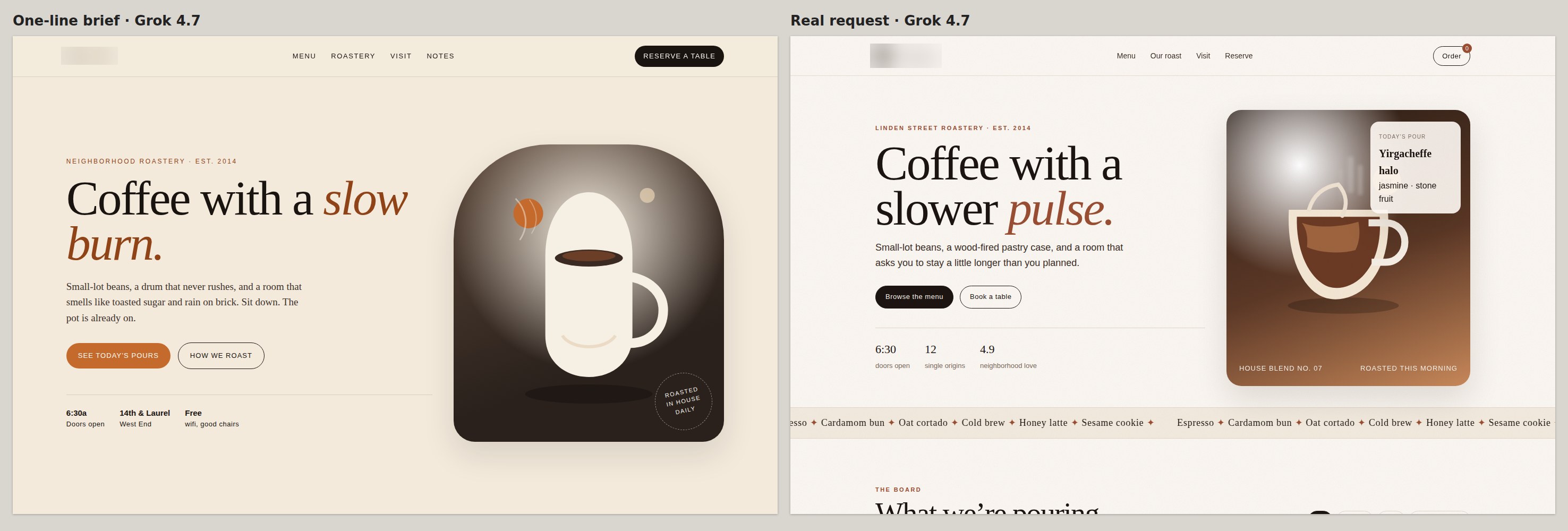
The navigation shows the same thing. On 66% of the AI pages, every link at the top jumped to a section further down the same page. On the human sites that happened about 2% of the time. Part of this gap comes from what I asked for. Every brief asked for one HTML file, and a single file has nowhere else to link. Some people did ask for several pages, though, and 59% of those pages still had only in-page links, against 71% for the rest. That split is rough, but even the lower number is far above the human sites.
Checking the comparison
The human sites in my October test were well-known companies, and few of them were small-business landing pages. So on the same day I reran the landing-page test with a fairer comparison, and wrote down the hypotheses first.
Seventeen models made pages for three briefs: a plumbing business in the UK, a weekly-planning tool for teams, and a family-run Italian restaurant. Each made three tries per brief, once with "No external images" in the brief and once without. For the human side I collected live landing pages in the same three categories, in English. That came to 12 plumbers, 11 planning tools and 9 restaurants. I measured every page at desktop width and at 390 pixels, the width of a phone.
The images line mattered because Claude Code had added it to my first test without my asking. I wanted to know whether it was producing the look. For most checks it wasn't. Of 18 visual checks that differed with the line in place, 5 shrank by half or more when images were allowed, and 6 grew.
Matching the human sites to the briefs did shorten the list. In the old setup, with only the plumber brief, no images and all the human pages I'd collected, 47 checks were more common on the AI pages at desktop width. With photos allowed, all three briefs and only the 32 matched human sites, it was 41. Of the original 47, 36 survived, 11 dropped out and 5 new ones appeared. I only counted a check when the difference held up statistically, allowing for the number of checks I was testing at once. 38 checks held at both desktop and phone width.
Share of pages with each habit at desktop width, AI pages and matched human sites
AI pages Human sites
Data
| AI pages | Human sites | |
|---|---|---|
| Small label above the headline | 93% | 25% |
| Elements that lift on hover | 88% | 6% |
| Em dash in the copy | 84% | 28% |
| Navigation that only jumps down the same page | 78% | 6% |
| One word set apart in the headline | 75% | 13% |
| Warm off-white background | 67% | 9% |
| Serif headline | 66% | 6% |
Navigation that only jumps within the page comes out higher here than in the real-brief run, at 78% against 6%. These pages had one-line briefs and seventeen models instead of seven. Small-business sites also use in-page navigation more often than the big popular sites in my older set. The gap is large in both runs.
The human sites did some things far more often. 88% showed a shadow on a field or button when it got keyboard focus, against 23% of the AI pages. Half used gradients with several colors, against 3%. Glow showed up on 38% of the human sites and 7% of the AI pages, which fits the October pages, where the dark glowing look was missing.
Share of pages with each choice at desktop width, AI pages and matched human sites
AI pages Human sites
Data
| AI pages | Human sites | |
|---|---|---|
| Shadow on a field or button with keyboard focus | 23% | 88% |
| Gradient with several colors | 3% | 50% |
| Glow | 7% | 38% |
The brief mattered here too. 26 of the 47 checks changed significantly between the plumber, the planning tool and the restaurant. The restaurant pages came closest to their human counterparts, with 15 to 19 checks more common on the AI pages, against 22 to 26 for the plumbers.
What I take from this
A real brief is worth writing. In this test it cut invented testimonials by about two thirds, and it made each model's pages less alike. It also made the models' pages for the same request about as different from each other as one model's pages for different requests.
What it barely touched was the styling and layout. The spaced capitals, the label above the headline and the navigation that stays on one page were all still there. This matches what I saw in Writing for an AI draftsperson, where real material changed the words and names and left the layout alone. If I want a page without those habits, a fuller description of the product won't get me there. I have to name the layout choices in the brief or make them myself.
What I don't know yet
Nineteen requests and seven models is a small set, and the requests all come from one public collection. Every brief asked for a single HTML file, and I didn't test a version that asks for several pages. The comparison with human sites in the real-brief run wasn't part of the plan I wrote down beforehand, and those human sites range from big popular sites to small ones. The checker reads code and styles, and it can't see hover styles on live sites, so I left that check out of the human comparison. Thirty-two AI pages hit the length limit and were measured as they came back.
The matched human set in the rerun is 32 sites in three kinds of business. 39 of the human desktop pages I collected had a consent dialog open when I measured them. These results describe pages made in November 2026.
Sources
- Real-brief run, November 1, 2026. 19 small-business website requests from WildChat (Wenting Zhao and others, WildChat: 1M ChatGPT Interaction Logs in the Wild, ICLR 2024), each sent as written and as a one-line template, with the same format line. 7 models from 6 labs at temperature 1, one page per request and version. 266 pages, 133 pairs, 47 checks. Cost $23.00. Human comparison added afterwards, against 383 live home pages and 414 live pages from my earlier tests.
- Landing rerun, November 1, 2026. 17 models, 3 briefs, with and without the images line, 3 tries each. 608 measurements across desktop and 390 pixels. Human pages from a live search, English only, 259 measurements kept of 286, with 32 sites matched to the briefs. Hypotheses written down before the run. Differences tested with Fisher's exact test, corrected for many comparisons (Benjamini-Hochberg).
- Earlier Lab posts: Asking AI models to design the same page (October 21, 2026), Changing the model or changing the brief (October 25, 2026), Writing for an AI draftsperson (November 14, 2026).