Ongoing practice-based research · Mustafa Bagdatli · since October 2024
Story, Gate, Ladder, Ledger
I have been building with AI coding agents almost every day since October 2024, about 21,000 commits across my own projects. They are fast and they sound sure of themselves, but they often hand back work that looks done and isn’t. Every time an agent’s work fooled me, I wrote down what happened and changed my setup so the same thing couldn’t get through again. Four principles came out of that. Each one has a name in my code, and the code enforces it, because telling the agent didn’t work. As I put it in one of these projects: “Verbal warnings, even specific and detailed ones, do not fix structural gaps.”
What does a person need to put in place so that work done by AI agents can be trusted, without reviewing every step?
Approach
I studied my own practice. I started with small apps on my laptop in October 2024. In spring 2026 I started building my own agent tooling, and then two bigger products: Loopstr, a workspace for running creative work through agents, and FieldVision, a camera game for kids that agents built almost entirely. I treated each failure as data. My repositories are the notebook: dated decisions, a ledger of lessons, the checks each lesson turned into, and a small test of builder models.
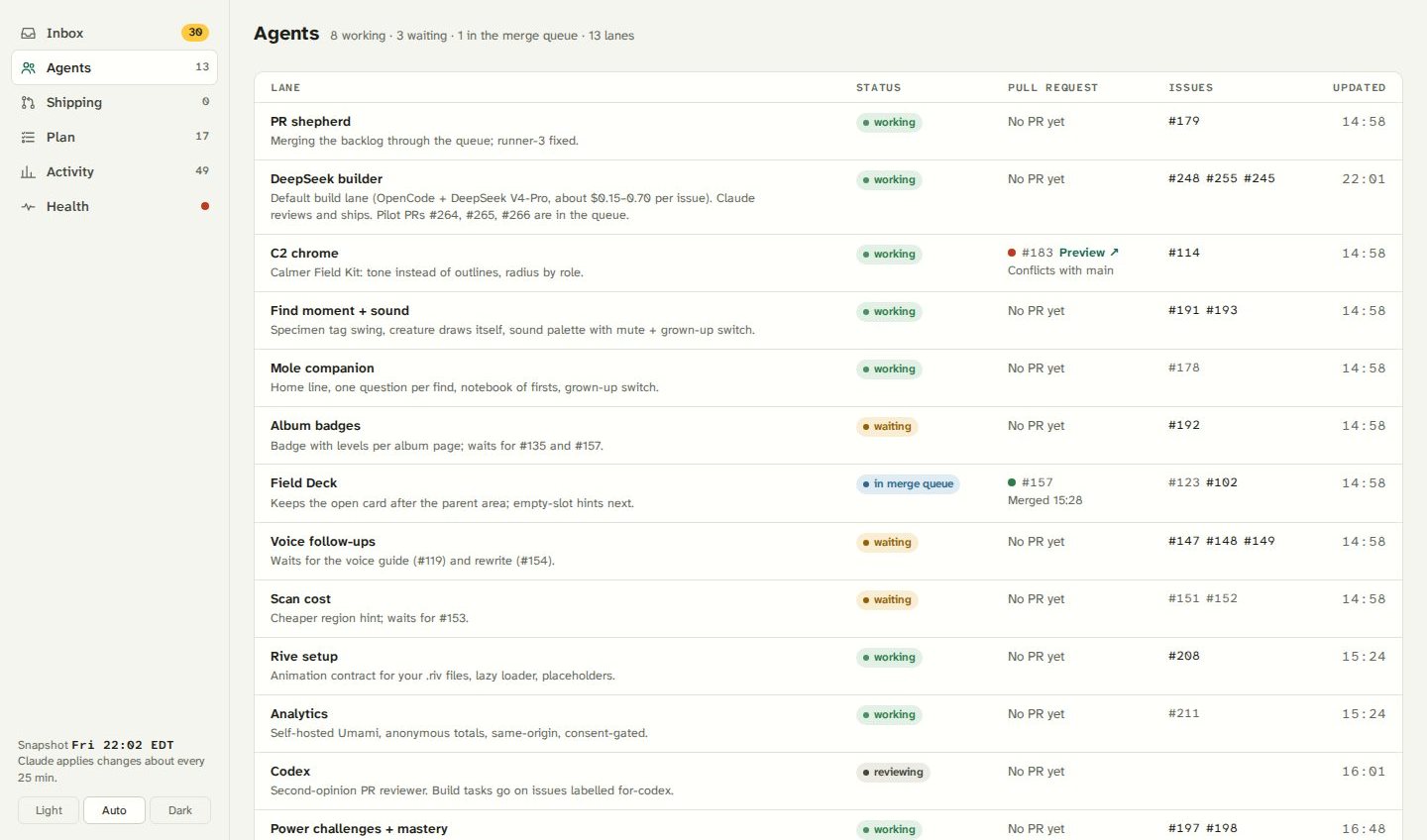
Finding 1 · Story
Agents say “done” before it is
Observation
When an agent says something is done, I learned not to take it literally. Once, an automated check reported a new part of a screen as tested, 2 out of 2, and that part had never even appeared on the screen. I started calling this “looks done but isn’t”, and it became the first thing I design against.
Principle
No story, no measure; no measure, no merge.
Loopstr, CLAUDE.md §1
Mechanism
So every change in Loopstr starts as a short story with a result you can measure. I commit the story first, on its own, while it still fails. Then the code. If the code comes first, CI rejects the branch. This still works when the branch gets squashed into one commit, because the story leaves a line in the commit message.
Evidence
The week I turned the gate on, 463 stories were written against 270 merged changes. A lot of untested work suddenly had to be measured. Since then the two numbers move together.
Open question
I don’t know yet if writing the story first means fewer bugs reach people, or only that I see them earlier. I need a comparison to answer that.
Finding 2 · Gate
If you approve everything, you stop reading
Observation
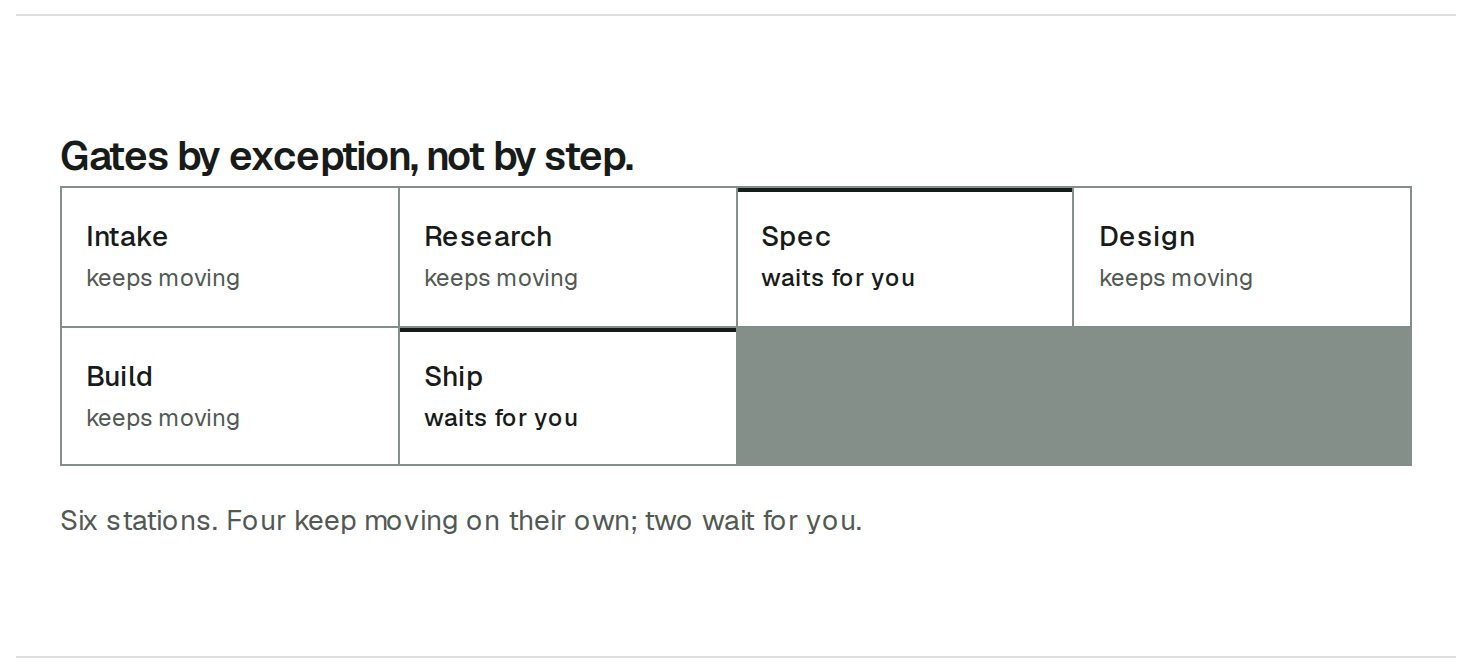
In the beginning my agents asked permission for everything, and I started clicking yes without reading. My gate code calls this “approval fatigue / rubber-stamping”. Then I realized most of what agents do for me (research, drafts, designs, builds) only creates files I can throw away. Only a few steps actually leave the system: publishing, deploying, creating a database.
Principle
The gate belongs where an action is hard to undo, not on every step.
Loopstr, GATE-AUTONOMY-LADDER.md
Mechanism
So each kind of step now says whether it can be undone. If it can, the agent moves on by itself when it is confident enough, 0.75 or higher. If there is no confidence signal, it waits. Verify, ship and app always wait for me. An automatic run has to stop before the first step it can’t take back, and a project can make its gates stricter but never looser. In Looper, five kinds of tasks always need a person, no matter how much trust the agent has earned.
Evidence
Open question
This rule changes where runs stop. I haven’t shown yet that it prevents real damage. I want to test it by planting risky actions in a sandbox.
Finding 3 · Ladder
A check can pass without checking anything
Observation
A test that can’t fail looks exactly like a test that passes. In Loopstr, one function was supposed to say “unknown” and returned a made-up confidence of 0.5 instead. It stayed there for months and let empty runs pass their own gate. Another time I compared what agents said their tests did with real runs: 2 out of 5 had reported results that never happened, even though the brief told them not to.
Principle
A check that cannot fail is not a check.
Loopstr, docs/LADDER.md; agents-discipline
Mechanism
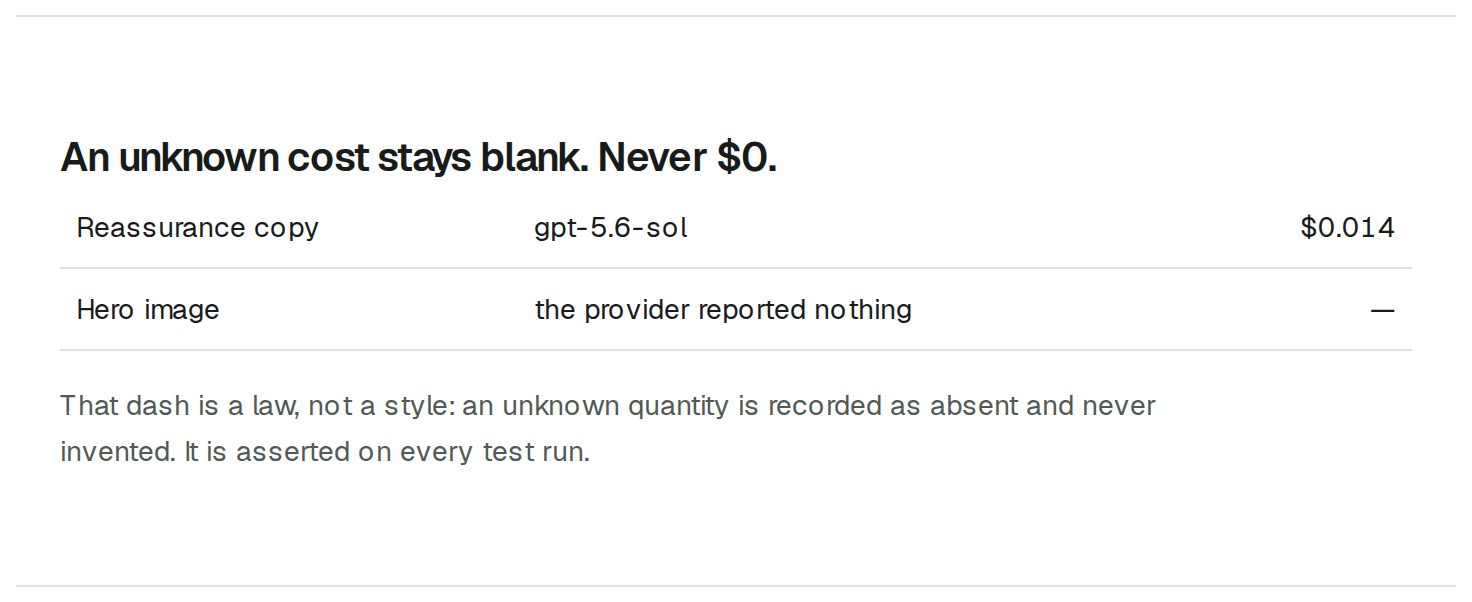
Every time I closed one way a check could fool me, I found the next one. I wrote them down in order, thirteen so far, each with the tool that catches it. Break the code on purpose and see if the test goes red. Run two cases that have to give different answers. Don’t show a claim as done until it points to a source. If a value is unknown, leave it empty, never fill it with a good-looking guess. Four of the rungs still don’t have a tool, and the ladder says that too.
Evidence
Open question
I don’t know if thirteen is the full list or if it keeps growing. Trying the rungs on tests that agents wrote for other people’s projects would tell me.
Finding 4 · Ledger
More instructions didn’t help
Observation
My first reaction to an agent’s mistake was to add another rule to its instructions. Loopstr’s rules file went from 392 words to 12,857 in nineteen days, and the same mistakes kept coming back. The lessons ledger started on the day I wrote “i thought we were but we werent.” A study published this year found something similar: these instruction files didn’t make agents more successful and made them about 20% more expensive.
Principle
A lesson gets exactly one home, in this order: CI gate, hook, skill, docs, prose.
Loopstr, CLAUDE.md §12
Mechanism
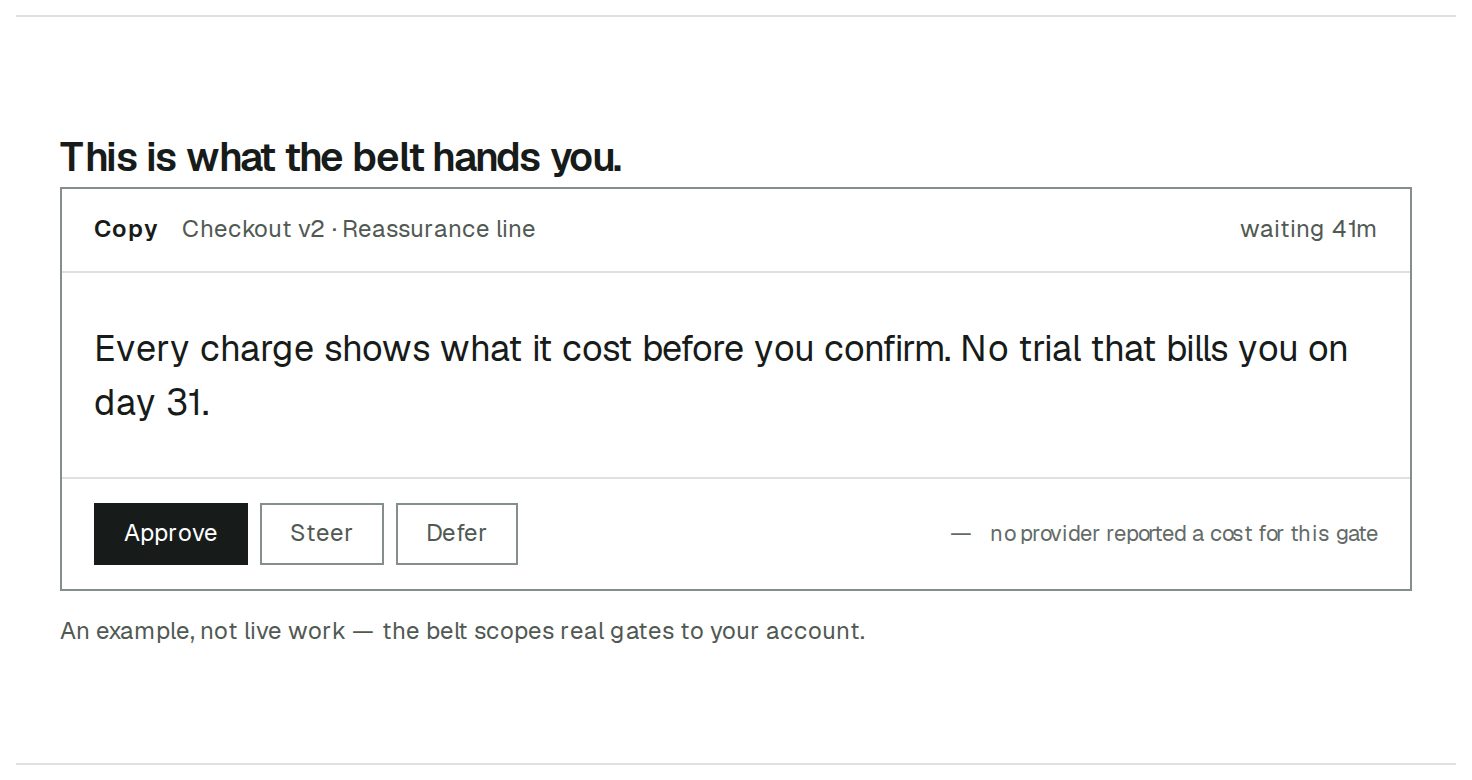
So now, at the end of each session, a hook saves the corrections I made, and the build won’t pass while any of them is unsorted. Each lesson goes to the strongest place it can live: an automatic check if possible, plain text only if nothing else works. The ledger also records what each of my decisions cost, and whether I gave it, steered it or left it to the agent. And my own words stay the way I wrote them. I didn’t want agents to keep “filtering my thoughts like a phone game.”
Evidence
Open question
The cost-per-decision part is built, but it barely has any data yet. Next I want to run it for a few weeks and see how much of the cost comes from my own steering.
Context
The two years behind it
Prior work
What is new, and what is not
Most of the ingredients aren’t new. People already write specs first, gate on reversibility, use mutation testing and track cost per run. So I searched published work to see which of my specific versions already exist. For the ones marked below, I couldn’t find a close match.
| Idea | Closest published work | Difference | Status |
|---|
The short version. Autonomy frameworks give an agent one level; I give each step its own, based on whether it can be undone, and an automatic chain stops before the first step that can’t. Mutation testing proves a test can fail; my ladder lists thirteen ways a check can verify nothing, with a tool for each. Observability tools price a run; my ledger prices a human decision and records who caused it.
Limitations and next studies
What this does not show yet
- There is no baseline yet. I need to do matched tasks with and without the method to see if it really means fewer bugs, or just moves the effort somewhere else.
- It’s one person’s practice: mine. Two or three other people using it, with interviews or think-aloud sessions, would show what carries over.
- Some numbers are small. The model test is four issues, and the fabrication rate comes from about ten agent runs.
- The ledger’s cost-per-decision data barely exists yet, and some rules, like keeping my words as written, are stated but not enforced.
- My own design critic got taste wrong on 3 of 6 test pairs. I kept that in the record, because the ladder has to apply to my own tools too.
Sources: my repositories Loopstr, Looper, Mission Control, agents-discipline, aic-pipeline-kit and FieldVision, read 13 October 2026, and a summary of my laptop’s git history. Prior work: Anthropic, “Building effective agents” (2024); OpenAI, “A practical guide to building agents” (2025); Feng, McDonald and Zhang, “Levels of Autonomy for AI Agents” (2025); GitHub Spec Kit (2025); Meta, mutation-guided test generation (FSE 2025); Gloaguen et al., “Evaluating AGENTS.md” (ICLR 2026); Langfuse cost tracking; git-ai; METR’s study of developer productivity with AI (2025).